
What Temp Do Candles Melt? Wax Temperatures by Type

Candle wax melts across a wide range, from about 115 degrees Fahrenheit for soft paraffin blends up to about 205 degrees Fahrenheit for the hardest microcrystalline wax, whose softer grades melt from about 145 degrees Fahrenheit, according to Hywax and Blended Waxes. Most candles use wax that is fully liquid by about 180 degrees Fahrenheit, a heating temperature that is higher than the melting ranges of soy, coconut, and standard paraffin, while beeswax, palm, and specialty waxes can melt at higher temperatures. The exact melt temp for candles depends on the wax type, its purity, and the brand’s blend. Knowing that number before you start keeps the finished pour smooth and prevents scorching, cracking, or a rough top.
What Temperature Does Candle Wax Melt At
The exact point depends on the wax type and formulation. Paraffin and soy sit toward the bottom of that range, while beeswax, carnauba, and microcrystalline wax need considerably more heat before they turn fully liquid. The chart below lines up nine wax types side by side so you can find yours without digging through separate product pages.
| Wax Type | Melting Point (°F) | Melting Point (°C) | Notes |
|---|---|---|---|
| Microcrystalline | 145-205 | 63-96 | Soft grades melt lowest, hard grades highest |
| Beeswax | 144-149 | 62-65 | Relatively steady melting point |
| Carnauba | 176-187 | 80-86 | High melting point |
| Hard base paraffin | 175-185 | 79-85 | Requires a second pour for containers |
| Rice bran | 172-180 | 78-82 | Natural option |
| Sunflower | 165-171 | 74-77 | Natural option |
| Paraffin (general) | 115-154 | 46-68 | Varies by grade |
| Coconut | 124-127 | 51-53 | Smooth texture, holds fragrance well |
| Soy (high melt) | 150 | 66 | Harder composition |
| Soy (standard) | 120-130 | 49-54 | Cleaner burn, lower melting point |
| Soy (low melt) | 130 | 54 | Softest composition |
Hywax lists paraffin, microcrystalline, and the specialty waxes across a 100°F to 195°F band, and Blended Waxes points to four variables behind that spread: chemical composition, purity, processing method, and wax crystal size and shape. Additives change the number too, so two bags labeled the same wax type can behave differently on the stove.
How Melting Points Vary by Wax Type
Melting points split roughly into two groups: plant and animal waxes that melt at moderate heat, and synthetic or specialty waxes that need much more. Knowing which group a wax belongs to tells you what kind of heat source and how much patience the project needs. A wax melter or warmer built for soy will often struggle to fully liquefy microcrystalline or carnauba, since those two sit closer to the safety ceiling than to the bottom of the chart.
Natural and Plant-Based Waxes
Soy wax can melt at about 120°F to 180°F, depending on formulation. Low melt soy runs about 130°F and high melt soy runs closer to 150°F, so the label matters more than the word soy on its own.
Coconut wax melts at 124°F to 127°F and is prized for a smooth finish and strong fragrance hold. Beeswax has a relatively steady melting point of 144°F to 149°F. Palm wax typically needs more than 140°F before it fully liquefies.
Synthetic and Specialty Waxes
Paraffin melts at 115°F to 154°F depending on grade and oil content, according to Lone Star Candle Supply, which heats hard base paraffin for pillar and hard-shell work to as much as 190°F before pouring; that figure is a heating target, not a melting point.
Microcrystalline wax sits at the top of the chart, but its grade decides how much heat it needs: Hywax gives 145°F to 195°F in one passage and 190°F to 205°F in another, and Blended Waxes sells grades from a soft 145°F melt point to a hard 195°F grade, the hard grades giving the finished candle superior heat resistance.
Carnauba melts at 176°F to 187°F, rice bran at 172°F to 180°F, and sunflower wax at 165°F to 171°F, and all three show up mostly in specialty or blended formulas rather than on their own.
What Affects a Wax’s Melting Point
- Chemical composition of the wax material
- Purity level of the wax
- Processing methods used during refinement
- Wax crystal size and shape
- Additives or impurities present in the finished blend
Blending two waxes changes the number again. Mixing beeswax into soy raises both the melting point and the hardness while boosting scent, and blending soy and paraffin wax is a common way to improve scent throw and burn time at once.
What Temperature to Pour Candle Wax After Melting
For candle making, melting point is different from heating and pouring temperatures. Paraffin container wax is poured at 150°F to 160°F, while paraffin votive wax is poured at 150°F to 170°F. Soy container wax may be poured from 90°F to 160°F, depending on the brand.
| Wax Type | Application | Pouring Temperature (°F) | Notes |
|---|---|---|---|
| Paraffin | Container or votive | 150-170 | Lower end gives smoother tops |
| Paraffin | Pillar | 170-180 | Needs a second pour |
| Paraffin | Hard base | 175-185 | Higher heat for density |
| Soy | Container | 90-160 | Varies significantly by brand |
| Soy | Melt and tart | 150-160 | Pour toward the warmer end |
Pouring soy wax at the cooler end of its stated range can produce smoother tops with fewer surface defects.
Since 2019, my Brother P-touch PT-D210 has labeled the manuals drawer, which is about the level of precision I can manage without creating a new problem to label. A soy container wax range of 90°F to 160°F, depending on the brand, deserves the same treatment: follow the product’s stated range rather than pretending one melting temperature settles the pouring decision.
How to Melt Candle Wax Without a Warmer
You can melt candle wax without a dedicated wax warmer by using a double boiler, a microwave, or an oven, and each keeps the wax off direct heat so it does not scorch. A double boiler gives the steadiest control for a full batch, while a microwave works fastest for a small amount of wax.

Candle wax double boilers heat wax gently with indirect steam, helping reduce scorching during melting and pouring. Compare saucepan inserts, dedicated melting pots, and electric models by capacity, stainless steel or aluminum construction, pour spouts, handles, temperature control, and compatibility with different stove types.
As an Amazon Associate we earn from qualifying purchases.
Double Boiler Method
- Set up the pot and bowl. Place a heat-resistant metal or glass bowl on top of a large pot of water, keeping the bottom of the bowl clear of the water.
- Bring the water to a gentle simmer. Use medium heat and stop before it reaches a rolling boil.
- Add the wax and start monitoring. Drop the wax into the bowl and track the temperature with a thermometer the whole time.
- Stir occasionally. Use a heat-safe tool as the wax softens and melts.
- Hold at 160°F to 180°F. That range fully melts most waxes without pushing past a safe ceiling.
- Remove and cool. Take the bowl off the heat carefully once the wax is fully liquid, then let it cool toward pour temperature.
Microwave Method
- Chop the wax. Break it into smaller pieces or use pellets so it heats evenly.
- Use a microwave-safe bowl. Ceramic and glass both work well.
- Heat in short bursts. Run one-minute intervals for a small batch, or two-minute intervals at first for a larger one, switching to 30-second bursts once the wax starts to soften.
- Stir between every burst. This spreads the heat and shows how much wax is left solid.
- Stop at 176°F. That is 80 degrees Celsius, the target Wax and Wick sets for microwave melting, while Lone Star Candle Supply heats most waxes to 180°F to 185°F.
- Cool to 158°F before adding fragrance or dye. That is 70 degrees Celsius, and adding scent or color sooner can weaken both.
Keep the thermometer out of the microwave itself. Leaving one in while the unit runs can damage both the thermometer and the microwave, and nobody should walk away while wax is inside.
Oven Method
- Preheat to about 175°F. That is roughly 79 degrees Celsius.
- Use an oven-safe dish. Set the wax inside once the oven reaches temperature.
- Stay close and check often. The sources behind this guide do not give an exact melt time for the oven method, so watch the wax rather than a clock, and never leave it unattended.
Worked Example: Melting a Batch of Soy Wax
Say you are melting soy wax flakes for a container candle and have no warmer on hand. Set up the double boiler, bring the water to a simmer, and add the flakes. Hold the wax at 180°F to 185°F until every flake has disappeared, then pull the bowl and let the wax drift down toward the soy container range. Because that pour window depends heavily on the brand, test a small pour partway down the range first, note how the top looks once it sets, and adjust the next pour a few degrees warmer or cooler from there.
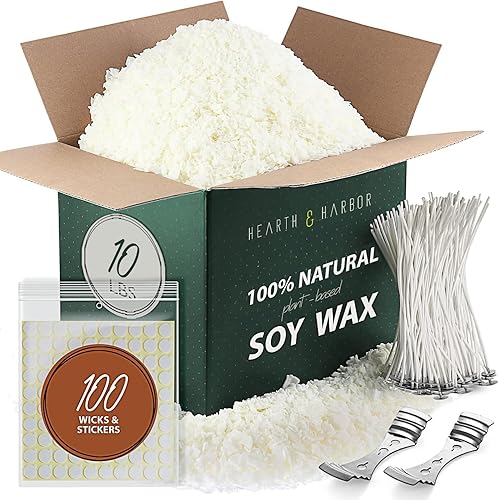
Soy wax flakes are plant based wax pieces used for container candles, melts, and blended wax projects. Compare melting point, additives, flake quantity, color, and whether the wax is formulated for containers, pillars, or wax melts.
As an Amazon Associate we earn from qualifying purchases.
Keep notes on what worked. A soy blend that sets cleanly at 130°F for one brand might need closer to 150°F from another supplier, and the only way to find that number is to log the pour temperature next to how the finished top looks once the candle cools completely.
Heat Gun, Foil, and Tealight Fixes for Small Repairs
A heat gun or hair dryer held about 6 inches above the surface can soften a thin layer of wax, which is useful for fixing tunneling or freeing a buried wick without melting the whole candle.
Covering the top of a candle with aluminum foil, leaving a 1-inch hole around the wick, traps heat and evens out a lopsided melt pool. A heat-resistant dish or bowl set over a softly burning tealight will slowly soften wax from above as the warmth rises, which works as a low, gentle fix rather than a full melt.
Safety Rules for Melting Candle Wax
Never let wax climb past 250°F, since that is the point most guides flag as a genuine fire risk. Always melt wax indirectly, through a double boiler, microwave, or oven, rather than over a direct flame or burner.
- Supervise the wax at every stage and never leave it unattended
- Keep melting wax away from children and pets
- Wear protective equipment such as oven mitts and safety goggles
- Keep a fire extinguisher within reach, and never pour water on a wax fire
- Use heat-resistant gloves when handling hot containers or bowls
- Work in a well-ventilated area
What to Do if Wax Overheats or Won’t Melt Evenly
If wax starts smoking or the temperature passes 250°F, pull it off the heat right away and let it cool on its own instead of adding water or ice. Water reacts violently with hot wax and can throw burning droplets, so a fire extinguisher rated for grease fires is the only safe response if the wax actually ignites.
Uneven melting usually comes down to piece size or heat that is too high. Chopping wax into smaller, similar-sized pieces, or switching to pellets, lets every piece reach liquid at close to the same rate instead of leaving solid chunks in the center while the edges scorch. Turning the heat down and stirring more often solves most of what looks like a stubborn, lumpy melt.
Frequently Asked Questions
What Temperature Is Too Hot for Candle Wax?
Safety guides agree that wax should never pass 250°F. Beyond that point the risk of the wax catching fire rises sharply, and even below it, prolonged high heat can scorch the wax and dull its scent.
Is It Safe to Melt Candle Wax in the Microwave?
Yes, as long as you heat it in short bursts and stop at 176°F. Stir between every interval, keep the thermometer out of the microwave while it runs, and stay in the room the whole time.
Why Do Different Brands of the Same Wax Melt at Different Temperatures?
Chemical composition, purity, processing method, and crystal structure all shift a wax’s melting point, and additives push it further. Two bags labeled soy wax from two different manufacturers can genuinely melt several degrees apart.
Can You Mix Different Types of Candle Wax Together?
Yes, and blending is common in candle making. Adding beeswax to soy raises the melting point and hardness while strengthening scent, and blending paraffin with soy is often used to improve scent throw and burn time together.
What Is the Difference Between Melting Point and Pour Temperature?
Melting point is the temperature at which solid wax turns fully liquid, while pour temperature is the cooler, more specific point at which that liquid wax should actually go into a container or mold. Pour temperature always sits below melting point, since the wax needs to start stabilizing before it sets around a wick.
Match the pour temperature to the wax type printed on the bag rather than to one number for every candle, and keep the thermometer in the wax itself until the moment you pour, not inside a running microwave. That single habit prevents most scorched batches, rough tops, and wasted wax.
References
- Heating and Pouring Waxes, Lone Star Candle Supply
- Wax Melting Point: Compare 100-195°F Ranges for Best Results, Hywax
- 5 Ways to Melt Candle Wax, Harlem Candle Co.
- Mastering the Art of Melting Wax: How to Avoid Burning It Using a Double Boiler, ARTISANE
- Candle Wax Melting Point Chart: Paraffin, Soy and Beeswax Guide, SER Wax Industry
- Melting Point Factors for Common Waxes, Blended Waxes
- How to Melt Candle Wax in the Microwave, Wax and Wick
- How to Melt Candle Wax Correctly: A Quick Guide, NI Candle Supplies
- Microcrystalline Wax, Blended Waxes
Sources read in September 2026.