
What Are Simulated Pearls? Crystal, Glass and Shell Types

Simulated pearls are manufactured imitations designed to look like natural or cultured pearls, but they are built in a factory rather than grown inside a mollusk. Manufacturers create them by coating a core, typically glass, plastic, resin, or shell, with a pearlescent finish that mimics real nacre. Common types include crystal pearls in the Swarovski style, glass pearls, shell pearls, and plastic or resin pearls, and each one differs in weight, durability, and price. Genuine cultured pearls take two to four years to form, as a mollusk deposits nacre layer after layer. Simulated versions get one coating applied in hours or days, which explains why they cost a fraction of the real thing.
Simulated Pearl Materials and Coatings
Core materials for simulated pearls include glass, plastic or resin, shell, and ceramic, and a pearlescent coating goes over the bead to mimic the look of nacre. The coating varies by type: high-quality lacquer, pearl essence, pearlescent paint, or a nacre-like synthetic substance, and that coating is what gives an inexpensive bead its shine.
Older methods relied on essence d’orient, a liquid guanine protein extracted from fish scales. Producing just 3.5 kilograms of it required roughly 20,000 fish. Modern manufacturers use synthetic pearlescent coatings instead, which cost less and perform more consistently than the fish-scale method ever did.
What Are Crystal Pearls (Swarovski-Style)
Crystal pearls are simulated pearls built on a manufactured crystal core, not plain glass, then coated with a pearl-like finish designed to emulate the shine of a natural pearl. Swarovski popularized the style, and the name has become shorthand for the category even when another brand makes the bead.
The coating on a crystal pearl is a single layer of nacre-like substance, which makes it more vulnerable to scratching than an authentic pearl’s many protective layers. Manufacturers can apply that coating in a wide range of colors and shapes, including baroque, pear-shaped, and flatback styles that do not occur in nature.
Crystal pearls also hold their color well and can mimic the look of Akoya, South Sea, or Tahitian varieties, part of why they outperform lower-tier simulated pearls like plastic on surface finish and durability. Their reflection tends to look mirror-like rather than showing the dimensional depth of real nacre, a difference a jeweler can usually spot at a glance.
What Are Glass Pearls
Glass pearls are beads made from wax-filled hollow glass or solid glass, then treated with a pearl essence coating or pearlescent paint. They typically look brighter than plastic pearls and feel heavier in the hand, since glass is denser than plastic, though the beads remain vulnerable to chipping or shattering if dropped.
A well-made glass pearl has a smooth surface and a fine texture that can look highly realistic from a short distance. Wear changes that picture over time, because the coating tends to chip away at edges and drill holes first, revealing the plain glass underneath.
What Are Shell Pearls
Shell pearls are made from compressed shell powder, ground mother-of-pearl or nacre mixed with a binding agent, shaped into beads, and coated multiple times. Polished natural shell pearls sit at the top of this category and can closely resemble real pearls, priced from $3 to $10 or more per bead.
Some shell pearls even include a small nucleus, similar to how a cultured pearl forms, which makes them visually difficult to tell apart from the genuine article. Sellers and appraisers describe shell pearls as more deceptive than glass or plastic imitations for exactly that reason. Despite the convincing look, shell pearls do not match a genuine cultured pearl for longevity or investment value, since the coating and compressed core cannot replicate decades of natural nacre growth.
What Are Plastic and Resin Pearls
Plastic and resin pearls are molded from synthetic resin, ABS plastic, or acrylic, then finished with a pearlescent paint or coating after molding. They sit at the bottom of the simulated pearl hierarchy and feel noticeably lighter than any other type, since plastic has the lowest density of the core materials used.
Coatings on plastic pearls tend to wear off faster than on glass or shell versions, which limits them to obvious costume jewelry rather than pieces meant to pass as real. Most plastic pearls also have a perfectly uniform, flat sheen instead of the dimensional luster real nacre produces. ABS pearls specifically work well for large earrings, since their light weight keeps big pieces comfortable to wear.
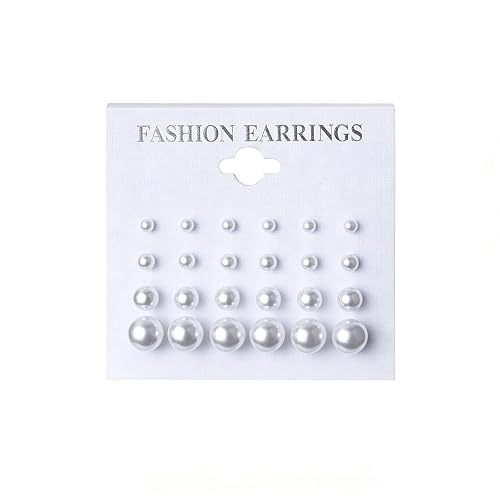
ABS pearl earrings use lightweight plastic beads with a smooth, pearl like finish for studs, drops, hoops and clip on styles. Compare pearl diameter, earring shape, metal type, fastening, and whether the pearls are paired with crystals or other decorative elements.
As an Amazon Associate we earn from qualifying purchases.
How Do the Main Types of Simulated Pearls Compare
The table below lines up core material, coating, durability, and price tier for each type of simulated pearl, including Majorica as its own line since its multi-layer process sets it apart from ordinary glass pearls.
| Type | Core Material | Coating | Durability | Price Tier | Key Trait |
|---|---|---|---|---|---|
| Crystal (Swarovski-style) | Manufactured crystal | Nacre-like single layer | High | Premium | Mirror-like reflection, wide color range |
| Glass | Solid or wax-filled glass | Pearlescent paint or pearl essence | Medium | Mid-range | Brighter look, chips if dropped |
| Shell (compressed) | Compressed shell powder with binder | Lacquer coating | Medium | Mid-range | Convincing look, sometimes has a nucleus |
| Shell (polished natural) | Polished natural shell or nacre | Minimal coating | Medium to high | Mid to premium | Most convincing shell type, $3 to $10 or more per bead |
| Plastic or resin | ABS plastic, acrylic, or resin | Pearlescent paint | Low | Budget | Lightweight, coating wears fastest |
| Majorica | Glass | Multi-layered proprietary coating | High | Premium | Founded 1902, virtually indistinguishable from real pearls |
Reading the table by price tier is often the fastest way to judge a piece before buying it. Premium tiers, crystal and Majorica, use costlier cores and multiple coating steps, and that extra work shows up directly in how long the piece holds its shine.
If I were choosing simulated pearls for regular wear, I would favor crystal pearls over glass or compressed shell. Their high durability and stable color make the premium price feel easier to justify, even though their reflection is less deep than genuine nacre. I would reserve plastic or resin for large earrings, where low weight has a clear comfort advantage. For pieces meant to look especially close to real pearls, polished natural shell would be my second choice.

Crystal pearls are simulated pearl beads with a crystal glass core and a pearlescent coating. They are used in jewelry making, beading, embellishments, and craft projects. Compare bead diameter, color, finish, hole size, and whether strands, loose beads, or mixed assortments suit the project.
As an Amazon Associate we earn from qualifying purchases.
What Is Majorica and How Is It Different from Other Simulated Pearls
Majorica is a Spanish brand of simulated pearl, founded in 1902 by Eduard Heusch in Mallorca, built around a glass core coated with many layers of a proprietary pearlescent substance rather than a single coat. By 1952 the company had developed a multi-layered technique that replicates how natural nacre accumulates, which is why a well-made Majorica pearl can be difficult to distinguish from a real one at a glance.
That layering is the main technical difference between Majorica and an ordinary glass or crystal pearl, which usually gets one coat of pearl essence or pearlescent paint. More layers mean better durability and a more convincing depth of shine, which is also why Majorica pearls sit in the premium price tier alongside crystal pearls rather than with plastic or basic glass versions.
How Do Simulated Pearls Differ from Genuine Pearls
Simulated pearls differ from genuine pearls mainly in how they form and are built in a factory around a coated core in hours or days. That gap in formation time shows up directly in durability and depth of shine.
- Genuine pearls build up many protective layers of nacre over time, which is why they hold up to decades of wear; simulated pearls carry only one coating.
- Real nacre grows as a biological response to an irritant inside the shell, while a simulated pearl’s coating is applied by machine with no biological process involved.
- A cultured pearl can become a family heirloom with lasting resale and investment value, while a simulated pearl is priced as costume jewelry and does not hold value the same way.
- Simulated pearls lack the layered growth pattern that gives genuine nacre its depth, part of why a loupe or a strong light can usually tell the two apart.
Cultured Pearls vs. Simulated Pearls: Which Are Real?
Human intervention begins a cultured pearl’s formation, but a mollusk completes it biologically. Simulated products do not undergo true nacre growth, even when their surfaces are designed to reproduce pearl appearance.
That biological origin is the key distinction. A cultured pearl forms in a mollusk after nucleus implantation. By contrast, crystal pearl describes certain simulated products with a crystal-based core. Swarovski says its Crystal Pearls pair a compact Swarovski Crystal core with a complex pearl coating.
Its positioning as an alternative to natural and cultured pearls also places it outside the cultured-pearl category.
A shell-derived simulated pearl remains separate from a cultured pearl. GIA classifies an object made of shell to look like a pearl as imitation material, whereas cultured pearls are real pearls created by mollusks. For product descriptions, FTC guidance requires artificial, imitation, simulated, or a synonym immediately before pearl.
How Are Simulated Pearls Labeled Under FTC Rules
Federal Trade Commission rules require any imitation pearl to carry the word “artificial,” “imitation,” or “simulated” immediately before the word “pearl,” or another term with the same meaning, as of September 2026. Retailers cannot bury that qualifier elsewhere in a product description. It has to sit right next to “pearl” and appear with equal conspicuousness.
The Federal Trade Commission has specifically found that the word “faux” alone does not satisfy this rule, since an ordinary shopper may not recognize faux as a clear substitute for imitation. Sellers also have to disclose any treatment, such as bleaching, dyeing, or irradiation, when that treatment is temporary, requires special care, or meaningfully affects the pearl’s value. A listing that reads “faux pearl necklace” without a clearer qualifier may not meet the commission’s own standard.
How Did Simulated Pearls Develop Historically
Simulated pearls date back to ancient Rome, where craftspeople coated glass beads with silver and layers of glass to imitate the look of a real pearl. That practice grew into an organized trade centuries later.
Venetian glass workshops were producing imitation pearls by the 13th century, and the trade became such a threat to pearl merchants that Venice made unauthorized production illegal, punishing violators with amputation and exile.
In the 17th century, a Parisian rosary maker named M. Jacquin patented what became known as Parisian pearls: hollow blown glass spheres lined with ground fish scales suspended in liquid, called essence d’orient, then filled with wax to match the weight of a real pearl. Paris and Rome grew into the leading manufacturing centers for simulated pearls by the 19th century, still relying on the same fish-scale essence technique Jacquin had patented two centuries earlier.
Frequently Asked Questions
Can You Tell Simulated Pearls from Real Ones at Home?
Yes, a few of the details covered above make it possible to spot most simulated pearls without special equipment. Plastic pearls feel unusually light, glass pearls feel heavier but can chip at the drill hole, and any bead with a perfectly uniform sheen and no depth to its luster is more likely simulated than genuine. A jeweler’s loupe brings out the difference more clearly, since real nacre shows a layered texture that a single pearlescent coating cannot replicate.
Are Simulated Pearls Worth Buying?
Simulated pearls are worth buying for costume jewelry, special occasion pieces, or anyone who wants the pearl look without pearl prices. Crystal, Majorica, and polished shell pearls hold up well enough for regular wear and can look convincing from typical viewing distance. They will not hold value the way a genuine cultured pearl can, so buyers should treat the purchase as jewelry rather than an investment.
What Is the Most Realistic Type of Simulated Pearl?
Majorica and polished natural shell pearls are generally the most realistic simulated pearls on the market. Majorica’s multi-layer coating process was built specifically to replicate how natural nacre accumulates, and polished shell pearls start from real nacre material rather than a plain glass or plastic core. Both types cost more than plastic or basic glass pearls, reflecting how much closer they come to the real thing.
Do Simulated Pearls Need Any Special Care?
Yes, simulated pearls need gentler care than jewelry made of harder gemstones, since their pearlescent coating is a surface treatment rather than a solid material all the way through. Keep perfume, lotion, and hairspray away from the beads where possible, since chemicals can dull or wear down the coating faster, and store pieces separately so they do not rub against harder jewelry. Once the coating on a glass or plastic pearl chips, the plain core underneath becomes visible and the piece cannot be restored to its original finish.
Why Are Some Simulated Pearls More Expensive than Others?
Price differences among simulated pearls come down to core material and coating quality rather than size alone. Crystal, Majorica, and polished shell pearls use costlier cores and multiple coating layers, which is why they sit in the premium and mid-to-premium tiers. Plastic and resin pearls use the cheapest core material and a single coat of paint, which keeps them in the budget tier even in large sizes.
Knowing which simulated pearl type sits in front of you, crystal, glass, shell, or plastic, mostly comes down to checking weight, coating depth, and price tier against the table above. The label matters too: FTC rules mean a listing has to call the piece artificial, imitation, or simulated pearl rather than just faux, so reading that wording carefully is often the fastest way to confirm what a piece actually is.
References
- Lesson 20: Artificial Pearls, Freshwater Pearl Wholesale (M.J. Pearls)
- Real vs. Fake Pearls: A Retailer’s Guide to Shell, Glass, and Cultured Pearl Differences, Pearls Wholesaler
- What is the difference between natural pearls and Swarovski pearls?, Crystal Parade
- Real vs Fake Pearls: 5 At-Home Tests That Actually Work, Whisper to the Pearl
- History of Faux Pearls, i-Bead Inc.
- What Are Artificial Pearls: Materials and Characteristics, Kiwified Emerald
- Are cultured pearls considered “real” pearls?, GIA
- In the Loupe: Advertising Diamond, Gemstones and Pearls, Federal Trade Commission
Sources read in September 2026.