
What Are the Concrete Blocks in Parking Lots Called?

The concrete blocks in parking lots are commonly called parking blocks or wheel stops. Other names include car stops, curb stops, parking bumpers, parking curbs, bumper blocks, and car stoppers. A wheel stop is a low barrier placed near the head of a parking space to help drivers position parked vehicles and limit ordinary vehicle overhang. Wheel stops can help define the end of spaces near walls, landscaping, or walking areas. These barriers were introduced in the early 1900s and can be made of concrete, metal, wood, plastic, recycled rubber, or rubber. Product performance depends on the specific wheel stop and its installation.
What Are the Concrete Blocks in Parking Lots Called
Wheel stop is the industry term for these concrete blocks, though the product goes by several regional names. Parking block, car stop, curb stop, parking curb, and bumper block all describe the identical item, and manufacturers use the terms interchangeably rather than to mark real design differences. The variation comes down to local habit and industry sector, not a different product. Nitterhouse Masonry and APC, two manufacturers that sell the item nationally, list several of these names on the same product page for exactly that reason.
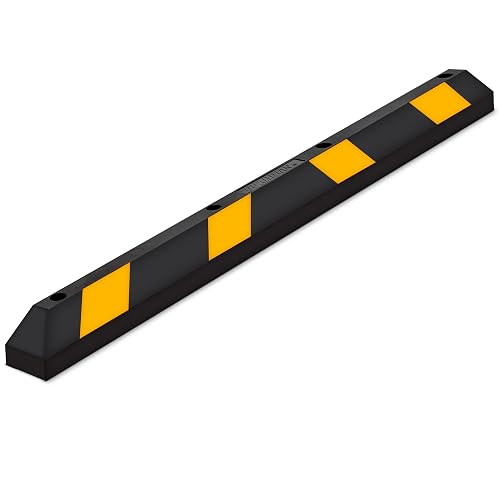
Concrete wheel stops are low parking barriers placed at the front of parking spaces to limit vehicle travel and protect curbs, walls, and landscaping. Compare overall length, height, weight, mounting holes, reflective markings, and whether models are intended for surface mounting or embedded installation.
As an Amazon Associate we earn from qualifying purchases.
The fixture dates to the early 1900s, making it one of the oldest fixed features in American parking lot design. Its basic job has not changed since then: a low, fixed barrier that a driver’s front tires meet before the car reaches a curb, wall, or walkway.
Why Parking-Lot Concrete Blocks Have Several Names
Wheel stop is the clearest umbrella term for the low barrier at the end of a parking stall. Parking block, car stop, and curb stop are also names for the same product, with use shaped by regional and trade terminology.
These names describe the fixed, low barrier used to guide where a vehicle stops within an individual parking space.
People do not rely on one universal single-word name. Users on English Language & Usage Stack Exchange report that wheel stop, parking curb, and parking block are common phrases, while Reddit users discussing the little cement blocks at the front of spaces called them parking blocks or wheel stops.
Chock block appears among related terms, but it does not mean the same thing in this setting. A chock block or wheel chock is distinguished from the fixed wheel stop installed at the end of a parking space.
Why Parking Lots Use Wheel Stops
These blocks help drivers position a parked vehicle and can limit ordinary vehicle overhang at the end of a parking space. That job can help define spaces near sidewalks, landscaping, building walls, and walking areas. A lot with clearly placed blocks can give drivers a visible reference point for where a space ends.
Property owners use these blocks for several practical reasons. First, a correctly selected and positioned block can limit ordinary parking overhang near a sidewalk or planting bed. Second, it gives drivers a physical reference point instead of relying on paint alone. Third, it helps define where one space ends and the boundary drivers park against, which can keep rows orderly in a busy lot.
Fourth, in retail settings where parking spaces face directly into a storefront, the block can help define the end of the space. Wheel stops are not vehicle-impact barriers and should not be relied on to protect a storefront from a moving vehicle.
Standard Wheel Stop Sizes and Weights
Standard parking blocks run 4 to 8 feet long, with 4, 6, and 8 feet the three common lengths sold by most manufacturers. Height typically falls between 4 and 6.5 inches, and safety guidance caps recommended height at 6.5 inches so the block does not become a taller trip hazard than necessary. Width generally runs 6 to 9 inches. Nitterhouse Masonry’s standard 6-foot model measures 6 feet long, 4 and 7/8 inches high, and 7 and 5/8 inches wide.
APC sells three precast concrete models sized for different traffic levels, shown below.
| Model | Length | Weight | Primary Use |
|---|---|---|---|
| CB04 | 4 feet | 105 lbs | Compact and residential spaces |
| CB06 | 6 feet | 165 lbs | Standard commercial parking |
| CB08 | 8 feet | 210 lbs | Larger spaces and high-traffic areas |
The weight matters for two reasons beyond stability. A heavier block resists being pushed out of place by a car that nudges it, and it also determines how many people an installation crew needs on site, a point covered in the installation section below. Manufacturers cast most models with two or three anchor points spaced evenly along the length, which lets an installer pick the anchoring method that fits the site without having to order a different block.
Concrete vs Rubber Wheel Stops
Concrete is the most popular and cost-effective wheel stop material for most parking lots, though rubber, plastic, metal, and wood versions exist too. It costs less up front, holds its position under vehicle weight, and can be repainted to mark reserved or accessible spaces. Rubber costs more, but a single worker can carry and place it without help.
Concrete’s main weakness is porosity: water works into the material over years and can cause cracking or crumbling, especially where the block sits in standing water or gets hit repeatedly by a plow blade. Rubber resists moisture well and will not crack the way concrete can, but it reacts badly to sun.
In warm climates, a rubber block left in direct sunlight can warp, soften, or partly melt. Plastic versions offer brighter, more visible colors out of the mold, but they crack under sustained pressure more readily than concrete or rubber.
| Attribute | Concrete | Rubber |
|---|---|---|
| Durability | Very sturdy for years, but porous and vulnerable to water damage | Resists moisture and will not crack easily |
| Climate weakness | Water exposure over time | Warping, softening, or melting in strong sun |
| Cost | More affordable | Higher upfront cost |
| Installation | Needs two people due to weight | Light enough for one person |
| Customization | Can be repainted for different zones | Precast color, cannot be repainted |
| End of life | Breaks down into inert dust with no toxic residue | Not addressed in the sources reviewed |
How Wheel Stops Are Installed
Installers anchor a wheel stop with rebar pins, bolts through the block’s cast-in anchor holes, or epoxy, depending on the surface and how permanent the placement needs to be. Pin anchoring drills through the block into the pavement below and drives steel rebar or a bolt into the hole, which works well on new asphalt or concrete. Epoxy bonding glues the block to an existing asphalt or concrete surface without drilling all the way through, a common choice for retrofitting an older lot. Some gravity-weighted setups skip anchoring altogether and rely on the block’s own mass to stay put, though this suits low-traffic areas more than a busy commercial lot. Cure time for epoxy bonding typically runs from a few hours to a full day depending on temperature and the product used, so crews often schedule the work for a slow business day to keep the spaces closed as briefly as possible.

Concrete wheel stop anchor pins secure parking blocks to concrete or asphalt surfaces, helping keep them in position. Options differ by pin diameter and length, rebar or steel construction, head style, and whether they are intended for new installations or replacement anchoring.
As an Amazon Associate we earn from qualifying purchases.
Concrete wheel stops in APC’s CB-Series have stated structural specifications. APC’s blocks test to a minimum of 4,500 pounds per square inch under ASTM C39, with two number 4 steel rebar bars cast in for reinforcement that meets ASTM A615 Grade 60. Nitterhouse Masonry’s standard block goes further, with a minimum compressive strength of 5,500 pounds per square inch and a maximum water absorption rate of 6.0 percent. Manufacturers vibrate the wet concrete during casting to settle it and eliminate air voids that would otherwise weaken the finished block.
A Worked Example: Ordering Wheel Stops for a Small Lot
Picture a strip mall owner who needs to line 10 parking spaces that face directly into the storefront. Each standard space calls for one 6-foot wheel stop, so the order comes to 10 units of the CB06 model at 165 pounds apiece, for a combined shipped weight of 1,650 pounds.
Because each block passes 100 pounds, the installation crew needs two people per block rather than one, which roughly doubles labor time compared with a rubber alternative at the same length. If the lot uses epoxy bonding on existing asphalt, the crew skips drilling but still needs the epoxy to cure before reopening the spaces to traffic, so scheduling installation during a slow business day avoids blocking active spaces.
Are Wheel Stops Required by ADA
The Americans with Disabilities Act does not universally require parking stops in every parking lot. That requirement applies in a narrower case: when an accessible route runs directly in front of a parking space, a wheel stop must be installed so an overhanging vehicle cannot reduce that route’s clear width below 36 inches.
Where a wheel stop is installed inside an accessible parking space, it must sit far enough back that it does not intrude into the 60-inch minimum-width access aisle a wheelchair user needs beside the vehicle. Federal guidance from ADA.gov lists a wheel stop that encroaches on an access aisle as one of the most frequently cited accessibility violations in parking lot design.
Beyond the federal floor, local governments set their own rules for when these devices are mandatory. Charlotte, North Carolina requires them under its local development ordinance whenever a parking space faces directly toward a building, a landscaped area, or a pedestrian pathway, and whenever the block is needed to protect the integrity of an accessible parking zone. North Carolina has no statewide mandate, so each municipality writes its own standard, and a property owner should check local ordinances rather than assume the federal ADA rule covers every case.
How to Maintain and Inspect Wheel Stops
- These barriers need a monthly check, plus an extra look after any snow event, for corrosion at the anchor points, cracking in the concrete, and blocks that have shifted out of alignment.
- Safety researchers have identified these low barriers as pedestrian tripping hazards for decades, and current guidance says they should not be placed in pedestrian walkways or foreseeable pedestrian paths.
- Where preventing vehicle encroachment is the objective, it recommends bollards at least 3 feet 6 inches high, centered at parking stall heads.
- Where a wheel stop stays in place, it should keep at least 3 feet of clear walkway beside it.
- Where a wheel stop stays in place, it should contrast visibly against the surrounding pavement color.
- Where a wheel stop stays in place, it should never sit inside a path pedestrians are meant to use.
- A block that fails inspection should be repaired or replaced promptly.
Skipping inspections lets small problems, such as a loosened anchor bolt or a cracked corner, turn into a tripping hazard before anyone notices.
Damage from failed epoxy, corroded bolts, water that has worked into the concrete, and repeated contact from snowplow blades are the most common causes of the cracking and misalignment that turn a wheel stop into a hazard rather than a safeguard. A cracked or shifted wheel stop can create a sharper trip hazard than leaving the space without one at all.
This guide does not set exact prices on this page; local suppliers and installation needs change the total.
Frequently Asked Questions
Do These Blocks Actually Stop a Car?
Only at very low speed. A wheel stop is built to catch a car creeping forward at parking speed, not to absorb a real impact. Current safety guidance treats bollards as a far more reliable vehicle barrier and recommends them over wheel stops wherever a stronger barrier is practical.
Can These Blocks Be Painted Different Colors?
Concrete blocks can be repainted, which lets a property manager mark reserved, accessible, or electric-vehicle spaces without ordering new blocks. Rubber stops come precast in their final color and cannot be repainted later. Concrete blocks are also sold made to order in bright yellow or a wood-grain finish, though both options carry a lead time of three to four weeks.
How Far Should a Wheel Stop Sit from a Sidewalk or Wall?
Guidance calls for at least 3 feet of clear walkway beside any wheel stop so pedestrians are not forced to step around it into traffic. The block should also contrast visibly with the pavement so it stays easy to see in low light.
Are These Required in Every Parking Lot?
No single federal rule requires them everywhere. ADA rules require accessible parking spaces and routes, not just routes in front of spaces, and cities such as Charlotte, North Carolina add their own local requirements tied to buildings, landscaping, or pedestrian paths. A property owner should check both the federal standard and the local ordinance before assuming either one covers a given lot.
How Long Do Concrete Blocks Last?
Concrete blocks can last many years both indoors and outside, longer than most rubber alternatives under normal use. Because concrete is porous, water exposure over time is the main cause of eventual deterioration rather than everyday vehicle contact. When a concrete block finally breaks down, it erodes into inert dust rather than leaving a toxic residue behind.
A wheel stop is a small fixture, but choosing the right size, material, and anchoring method affects how long a parking lot stays safe and how much maintenance it needs later. Owners who match the block to their traffic level, follow the anchoring method suited to their pavement, and keep up a monthly inspection get the longest service life out of either material.
References
- Wheel Stop (Parking Block) Safety Expert Article, Robson Forensic
- What Are Concrete Wheel Stops?, ProLine
- Concrete Parking Stops & Wheel Stops, APC Wheel Stops
- Concrete Parking Blocks, Curbs & Wheel Stops, Nitterhouse Masonry
- Concrete Parking Stops or Rubber Parking Bumpers?, Nitterhouse Masonry
- ADA Compliance Brief: Restriping Parking Spaces, ADA.gov
- When Are Wheel Stops Required?, ProLine
Sources read in September 2026.