
What Is a Gunnel on a Boat? Gunwale Meaning and Location

A gunnel on a boat is the top edge of the hull, the rim that runs along both sides from bow to stern where the hull meets the deck. Spelled “gunwale” in most dictionaries and said as “gunnel” either way, it is part structure and part safety rail. It stiffens the hull so the sides cannot flex or twist, gives passengers something solid to grab, takes the knocks from docks and pilings, and carries cleats, rod holders and lifelines. On a small aluminum skiff it may be a single rolled lip. A cruiser can have a full assembly of inner rail, outer rail, cap and drain holes.
Finding the Gunnel on a Boat
The gunnel sits at the very top of the hull side, running the full length of the boat on both sides, at the line where the hull meets the deck. Anyone standing next to a boat can find it in seconds, because it is the edge you have to step over to get aboard.
Wikipedia defines it as the top edge of the side of a boat. UK Sailmakers calls it the upper edge or rim of a boat’s side running along the length of the hull, and Marine Insight places it at the junction between the hull and the deck, which is the most useful way to picture what you are looking at.
Height above the water varies a lot. On a canoe or kayak the gunnel is only a few inches above the waterline and doubles as the frame that holds the hull shape. A center console has a gunnel that is chest high on an adult and wide enough to sit on. Deck boats and cruisers usually cap the gunnel with a molded rail so the finished edge is smooth, which hides the structural part underneath but does not change what it is.
How to Find the Gunnel on Your Boat
Look for the horizontal seam at the top of the hull side, then follow it forward and aft, because that unbroken line is the gunnel.
- Stand alongside the boat. Find the highest continuous edge of the hull side, below any windshield, rail post or canvas frame.
- Follow it forward. The edge should sweep up toward the bow and meet its opposite number at the stem.
- Follow it aft. On most powerboats the line ends at the two transom corners.
- Feel for the cap. A flat or rounded top surface an inch or two wide is the gunnel cap covering the joint.
- Look underneath. Reach under the lip from inside the boat, where screws, bolts or rivets show you the mounting hardware holding the assembly to the hull.
Gunnel or Gunwale: Which Spelling Is Correct
Both spellings are correct and both are said the same way, as “gunnel”. Gunwale is the older written form and the one used in naval architecture writing such as Marine Insight and UK Sailmakers. The phonetic version, gunnel, matches how sailors have always pronounced the word, and it is common in American boating coverage including Discover Boating. Neither spelling is wrong, so follow whichever one your owner’s manual uses.
What the Gunnel Actually Does
A gunnel does four jobs at once: it stiffens the hull, gives people a handhold, absorbs impacts from docks and other boats, and provides a mounting point for hardware. Many also manage water, either draining the deck through scuppers or blocking spray that would come aboard.
Structural Support for the Hull
Structurally the gunnel is a stiffening beam running the length of the boat, and without it the hull sides would flex and twist under load. Marine Insight and Maritime Page both describe it as tying the hull together and spreading loads along the top edge instead of letting them concentrate in one panel. Think of the way a picture frame holds a stretched canvas flat. Remove the frame and the canvas goes slack, and a thin hull skin behaves the same way once its top edge loses stiffness.
Handholds and Passenger Safety
For anyone moving around a boat underway, the gunnel is the nearest thing to grab, which is why Discover Boating treats it as a safety feature rather than trim. Grip it from inside the boat, keep your weight low, and move one hand at a time in chop. Sitting on it is a different matter, and a common way for people to end up over the side when a wake arrives.
Impact Protection and Docking
The gunnel takes the first hit in any contact with a dock, a piling or another boat, so it is usually the toughest part of the hull side. Fenders hang from cleats and rails mounted on or just below it, and dock lines run from the same hardware. Maritime Page names shielding the hull shell from impact as one of the core purposes of the gunnel, and that is why many working boats add a rubber or steel rub rail along the outer edge.
Mounting Points for Cleats and Rod Holders
Almost every piece of deck hardware on a small boat fastens to the gunnel, because it is the strongest continuous structure at a convenient height. Cleats, rod holders, lifeline stanchions, downriggers, grab rails and navigation light bases all land there. Boat Bliss Blog lists mounting hardware as one of the five parts of a gunnel assembly for exactly that reason, since the fasteners holding the rails to the hull also carry the loads from anything bolted on top.
Drainage and Splash Protection
Water management is the job people notice least. Many gunnels carry scuppers, small drainage holes that let water crossing the deck escape over the side instead of collecting inside the boat. Discover Boating and Boat Bliss Blog both describe those holes as a standard part of the design. Raised gunnels also work as a barrier in rough water, knocking down spray that would otherwise come straight in over the side.
Modern Use of Gunnel on Fishing Boats
On fishing boats, “gunnel” remains a current name for the gunwale, the top edge of the boat’s side. Anglers use that edge as a working area for rod holders, accessory tracks, equipment storage, and other angling accessories. Some gunwales are strengthened or widened to carry fixtures such as rod holders or cleats.
Current reference usage preserves the term in precisely that fishing context. In its July 29, 2026 example sentence, Merriam-Webster refers to an IGFA rule concerning rods in boat gunnel holders. The wording identifies gunnel holders as rod-holder locations on the boat’s side edge.
Use “gunwale” where conventional nautical spelling and precise labeling matter, then explain that “gunnel” is the spoken form and an accepted alternate reference for readers. That choice prevents a fishing-boat discussion from colliding with another dictionary meaning of gunnel: a small, slimy, eel-like North Atlantic bony fish, Pholis gunnellus, or a fish in the family Pholidae.
Gunwale is pronounced “gunnel,” not “gun whale.”
The Parts of a Gunnel
On most modern boats the gunnel is an assembly rather than one piece: an outer rail, an inner rail, a cap over the joint, the fasteners that hold it all together, and drainage holes through it. Boat Bliss Blog breaks it into exactly those five parts, and knowing the names makes repair quotes and parts diagrams far easier to read.
Outer Rail, Inner Rail and Gunnel Cap
The outer rail is the topmost structural section along the outside of the hull, usually wood, aluminum or fiberglass, and it carries most of the impact and hardware loads. Inside it sits the inner rail, a second member that backs up the outer one and gives fasteners more material to bite into. Over the joint goes the gunnel cap, a molded or milled cover that sheds water away from the seam and keeps it out of the boat’s interior.
Mounting Hardware and Drainage Holes
Screws, bolts, rivets and clamps tie the rails to the hull, and they are the first thing to check when a gunnel feels loose. Drainage holes run through the assembly at intervals so water cannot sit inside the cavity between the rails. Blocked holes are a slow problem rather than a dramatic one, since trapped fresh water rots wood cores and trapped salt water corrodes aluminum and steel fasteners from the inside out.
What Gunnels Are Made Of
Gunnels are built from wood, aluminum or composite materials such as fiberglass and carbon fiber, and the choice follows the boat’s design, its intended use and the owner’s budget. Traditional hardwoods look best and ask for the most work, while aluminum and composites trade some of that character for lower upkeep.
| Material | Properties | Maintenance | Best For |
|---|---|---|---|
| Wood (oak, teak, maple, cherry, mahogany) | Traditional look, strong, holds fasteners well, heavier | Regular cleaning, renewed protective coatings, prompt repair of scratches and dents | Classic boats and restorations where appearance matters |
| Aluminum | Lightweight and corrosion resistant | Lower than wood, with corrosion monitoring at fittings | Modern skiffs, jon boats and utility hulls |
| Composite (fiberglass, carbon fiber) | Strong, durable, low maintenance | Minimal, mostly washing and checking for cracks | Production boats built around durability |
Wood Gunnels
Oak, teak, maple, cherry and mahogany are the hardwoods named by UK Sailmakers and Maritime Page, chosen because they hold fasteners well and survive constant wetting. They also ask for the most attention. Varnish or oil has to be renewed on a schedule, scratches let water into the grain, and a neglected wood gunnel can go from cosmetic damage to soft, punky wood in a couple of seasons.
Aluminum and Composite Gunnels
Aluminum is the practical choice on smaller modern boats, being light, corrosion resistant and easy to extrude in long sections. Composites such as fiberglass and carbon fiber cost more but shrug off salt water and need little beyond washing. Neither material is immortal. Aluminum pits where dissimilar metals touch it, and fiberglass caps craze and crack where they have been overtightened or hit hard.
Where the Word Gunwale Came From
The word is a compound of “gun” and “wale”, an old term for a plank or raised band along a ship’s side. Fighting ships of the 15th century mounted cannon on deck platforms at the top edge of the hull, and that reinforced band, the gun ridge, took the recoil and spread it into the structure. Discover Boating traces the sailors’ usage to that period, and Marine Insight and Maritime Page both describe the original as reinforcement for mounting guns rather than a rail for people to hold.
Guns left the gunwale long ago, but the structural idea stayed put. A modern gunnel still takes concentrated loads, just from cleats, davits and dock impacts instead of artillery. Pronunciation kept the old shorthand of working sailors, which is why a word written with a w is still said as “gunnel”.
How to Inspect and Maintain a Gunnel
Check the gunnel for cracks, loose fasteners, corrosion and soft or split wood at least once a season, and always before heading out in rough weather, which is what PredictWind advises in its glossary entry. Cleaning is simple: mild soap and fresh water to lift salt off, then a protective coating suited to the material.
A Season Opening Inspection Routine
- Wash first. Salt and grime hide hairline cracks, so clean the whole rail with mild soap and rinse it before looking closely.
- Sight down the line. Crouch at the transom and look forward along the gunnel, where a dip, a bulge or a wavy section points to a failure underneath.
- Press and twist. Push down on the cap every couple of feet and try to rock each cleat or rail base, since movement means loose fasteners or a soft core.
- Check every fastener. Look for weeping rust stains, missing screws, and bedding compound that has cracked away from the head.
- Clear the drains. Flush water through each drainage hole and confirm that it runs out the other end.
- Treat the surface. Renew varnish or oil on wood, touch up the protective coating on aluminum, and wax gelcoat so the surface sheds water.
Cleaning by Material Type
Wood wants mild soap, a soft brush and a fresh coat of varnish or oil once the surface dulls. Aluminum needs the same wash plus attention to any white powdery corrosion, which should be cleaned back and sealed before it creeps under fittings. Fiberglass and composite caps clean up with boat soap and stay protected with wax, and any chip that exposes the laminate is worth filling rather than leaving open to water.
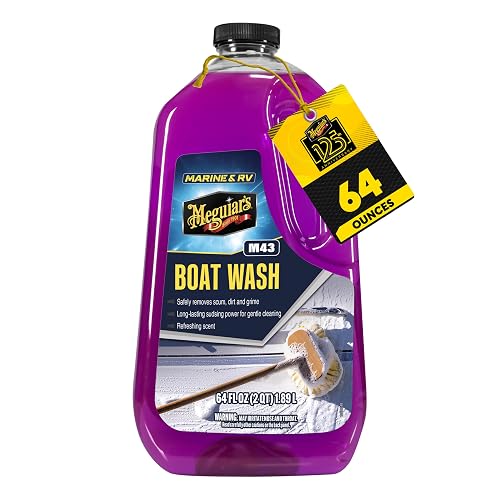
Boat soaps are cleaners formulated to remove dirt, salt residue, fish stains, and grime from hulls, decks, and other marine surfaces. Options include concentrated liquids, biodegradable formulas, and wash and wax products, with differences in intended surface compatibility, dilution ratios, and container size.
As an Amazon Associate we earn from qualifying purchases.
What to Check When a Gunnel Is Damaged
Stop using a damaged gunnel as a handhold or a mounting point until you know how deep the damage goes, then work from the outside in: cap, fasteners, rails, and finally the hull to deck joint underneath. Most problems that look cosmetic turn out to be a fastener or a drainage issue, and most that are structural show up as movement rather than as a visible crack.
Work through the likely causes in order.
- Cleat or rail moves under load. Bolts have backed off or the material under the backing plate has crushed. Rebed and retighten the fitting, and replace the backing if what sits under it is soft.
- Water sitting inside the gunnel cavity. Drainage holes are blocked or the cap seam has opened. Clear the holes first, then rebed the cap.
- Soft or dark wood. Rot has started. Sound sections can be cut back and a new piece scarfed in, but wood that crumbles under a screwdriver tip means replacing the whole section.
- White powder or pitting on aluminum. Corrosion, usually where stainless hardware touches the rail. Clean it back, seal it, and isolate the two metals with a nylon washer or bedding compound on reassembly.
- Cracks radiating from a screw hole in fiberglass. The fastener was overtightened or overloaded. Grind out the crack, fill with thickened epoxy, then redrill and rebed.
- Damage whose bottom you cannot see. Anything reaching the hull to deck joint is a structural repair rather than a weekend job, and a surveyor or yard should look at it before the boat goes back in the water.
None of the standard references give load ratings or thickness specifications for gunnels, and that gap is genuine rather than an oversight, because those figures are specific to each hull and come from its builder. If you plan to mount a heavy davit, a hardtop leg or a downrigger, ask the manufacturer for the reinforcement detail at that station instead of guessing from how solid the rail looks.
I like hardware stores when I need nothing, mostly because they make every tiny fitting seem like an invitation to inspect something I had ignored. That instinct applies to a damaged gunnel: a loose rail, cracked cap, or compromised fastener near a cleat or drainage hole merits a closer check, especially if damage may reach the hull to deck joint.
This guide does not compare material costs on this page; the right choice depends on the boat, finish and intended use.
Frequently Asked Questions
Is Gunnel the Same as Gunwale?
Yes. Both spellings name the same part, the top edge of a boat’s side, and both are pronounced as “gunnel”. Gunwale is the traditional written form used in naval architecture, while gunnel matches the spoken version and turns up more often in everyday American boating writing. Pick one and stay consistent.
Where Is the Gunnel on a Boat?
It runs along the top edge of the hull on both sides, from bow to stern, at the line where the hull meets the deck. On a small open boat that is the edge you step over to climb in. Larger boats cap it with a molded rail, so look for the finished horizontal surface at the top of the hull side. Anything above it, such as a windshield or a lifeline stanchion, is mounted to it rather than part of it.
Why Is It Called a Gunwale?
The name comes from “gun” plus “wale”, a plank or reinforcing band along a ship’s side. Warships from the 15th century onward mounted cannon along that reinforced upper edge, so the band became known as the gun wale. Modern boats kept both the structure and the name long after the guns were gone.
Can You Sit on the Gunnel?
Many boats are built with wide gunnels meant for sitting, and at anchor in calm water that is what they are for. Underway is a different matter. Sitting up there puts your weight above the rail, so a wake or a sharp turn can send you over the side, which is why the gunnel is better used as a handhold once the boat is moving. Use the seats instead and keep one hand on the rail as you move around.
What Is a Gunnel Cap Made Of?
Gunnel caps come in the same materials as the rails they cover: hardwood, extruded aluminum, or molded fiberglass and other composites. The cap’s job is to cover the seam between the inner and outer rails and shed water away from it, so it takes the sun and shows wear before the rest of the assembly does. Because the cap is a cover rather than a load carrying rail, damage there is usually less serious than damage to the rails underneath.
Do All Boats Have Gunnels?
Nearly every boat with hull sides has one, even when the spec sheet calls it something else. Canoes and kayaks carry gunnels along the top of each side that hold the hull in shape. Large ships have them too, where the deck edge meets the shell plating. What changes from one vessel to the next is the size, the material and how much of the structure hides behind trim.
Knowing the gunnel by name is worth more than it sounds. It is the part a yard means when quoting a rail repair, the part a fitting instruction refers to when it calls for a backing plate, and the first place to look when a boat feels loose or holds water on deck. Give it a wash, a sight down its length and a check of its fasteners at the start of each season, and most gunnel trouble stays small.
References
- Gunnel, Wikipedia
- What Is a Gunwale on a Boat, Discover Boating
- Gunwhale: Definition and Location, PredictWind
- Gunwale: The Upper Edge of a Boat’s Side, UK Sailmakers
- Gunwale on a Boat: Definition, Location, Materials, and Functions, Maritime Page
- Gunwale: Definition, Location, Purpose, and Materials, Marine Insight
- Gunnel: Definition, Anatomy, Functions, and Maintenance, Boat Bliss Blog
Sources read in September 2026.